| �@The residents around Kashiwara suffered
from flooding of the old Yamatogawa river
on May in the 6th year of Genna (1620). Immediately
after the flood Sueyoshi Magozaemon, who
was a local magistrate of county Shigi, made
an application to revive Kashiwara and let
Hirano more prosperous to the authorities
for permission on transport by vessel in
the Hiranogawa river. But the permission
was not given by Osaka Machibugyo (Osaka
magistrate) at that time. The planned transport
was realized in the 13th year of Kanei (1636).
The route was from Kyobashi to Hirano, Kashiwara
and a place of refuge was set up around Kokonoikeguchi.
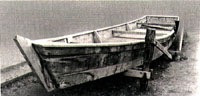
The vessels were 40 at the beginning and
later reached to 70. Each of them was about
12 meters in length, about 2 meters in width,
15�`20 kokus (a koku is 180 liters) in weight
and 2 watermen were always put in position.
The vessels mainly took a cargo of rice on
board, which was product of the other regions
and was available for cotton farmers, of
manure for cotton called Hoshika (dried sardines).
The transport declined with the renewal of
the Yamatogawa river owing to an unsatisfactory
water supply from only one water-gate and
accumulated earth and sand. They took measures
to meet the situation by dredging the river
and decreasing the quantity of a cargo. The
railroad was beginning to develop at that
time and the Kansai line was opened to traffic
in the 22nd year of Meiji from Minatomachi
to Kashiwara. The transport by vessel was
replaced with that of train in the 40th year
of Meiji, closing the 270 years of its glorious
history. |